I read chapter 1 of the Fundamentals of Physical Volcanology last night. Beer in hand, of course (what kind of geologist would I be if I didn't have a beer on a Friday!?). It was just chapter 1, so the overview. Now it is morning and I am blogging with coffee in hand and cat on leg.
A little bit about where/when/why I got this text book. In grad school I took a 600 level physical volcanology class; that was a few years ago, (already!) and I very much enjoyed the more in depth approach of this class. But, like all classes, it was too short and we did not get to cover nearly enough. I think the fact that this book was for a graduate level class, shows a little bit in the introduction. It assumes a basic knowledge about geology, and does not (like a lot of my text books) have the following image in chapter 1.
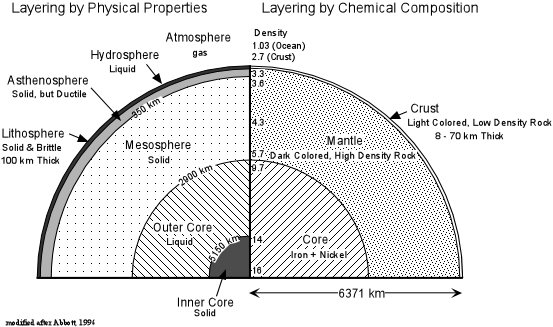
Yeah, the structure of the earth. I mean, I know it is good to just keep seeing it over and over and over so it sticks but... in grad school I was getting a little sick of the "hokay so here is the earth" and my reaction was always FOR FUCKS SAKE I KNOW! STOP WASTING TIME!!!
So I was happy it wasn't there. Now, on to what was there! I felt like the groundwork was set well for a discussion that goes beyond the basic "this is a volcano and this is what it does". I have read this book before so I know what some of the issues are that it brings up. I liked that it included an introduction to the idea that there are problems with the different ways eruptions are classified and that it can be a little fuzzy in the gray area between the well defined types. But I am not here to review text books.
This chapter made me excited. Why? Well after you have taken a few volcanology classes I feel like you spend enough time with the classic eruptions that you start to develop relationships with them. I see that wonderful painting of Mount Vesuvius next to a blurb about Pliny the Younger and it makes me smile. It is like seeing an old friend.

Also there was a sense of excitement because, unlike most classes, I do not have a time limit for reading this book. I don't have to cut anything short for the sake of the end of the semester. I always have felt that because, classes get behind with good discussions, things like diatremes, large igneous provinces and M.O.R. eruptions get less time than they deserve. Now I can go through the book and give them equal time.
So welcome to this crazy journey of a scatter brain to discover things I should have remembered but didn't as I reread my text book. (Volcanology edition)

2 comments:
I found that it was always a good idea to take classes twice or even three times (Wish I had acted on my own advice more often). With a good lecturer, you will start going into the things that normally fall by the wayside. By asking questions, by having the tutors hand you little extra add-ons while everybody else is still slaving away on the first drawing of something, by chatting with the lecturer (=scientist!) during the breaks, by getting thick books shoved at you at every opportunity, by snagging the high-profile student helper jobs. I learned some amazing stuff this way - and that stuff stuck!
However, German universities having been reformed (Bolgona process - ugh! how can something so abjectly horrible be named after the same town as the delicious meat sauce???), we now have the same ghastly system of graded and counting to final grade exams twice a course.
So I guess those good times are over.
"Hi he, Hi ho,
the school is out, we go
we learn some junk,
and then we flunk.
Hi he, hi ho!"
Post a Comment